Contist extracts, indexes, and structures prosecution history from USPTO and EPO into timelines, claims evolution graphs, and portfolio-level signals — automatically.
Your portfolio, your prosecution history, and your docket — synced from USPTO and EPO, structured into events you can actually query.
contist.ai/claims/3/lifecycle
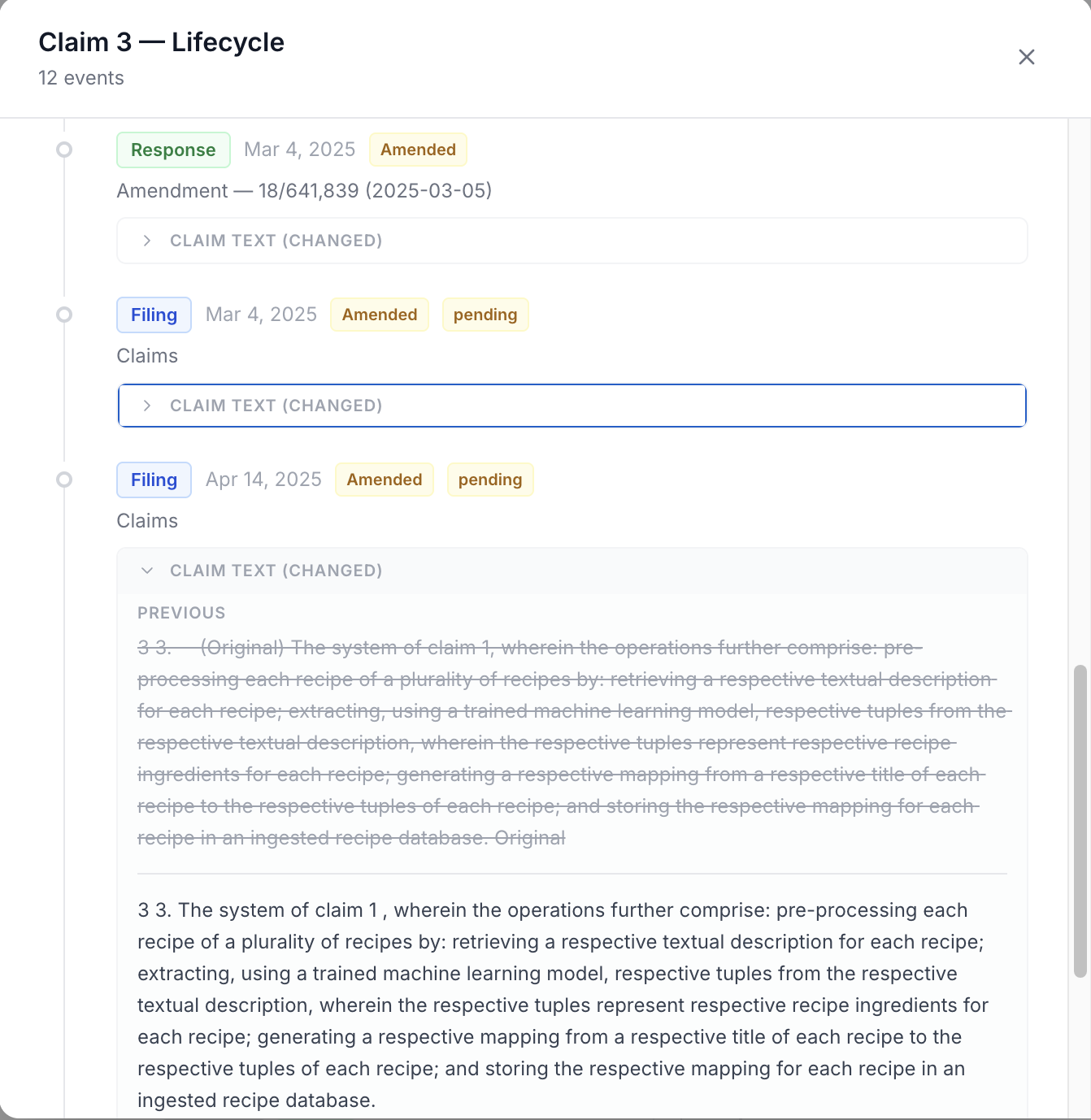
Claim lifecycle — every amendment, argument, and rejection as a structured event. Per-claim evolution and first-vs-any comparisons one query away.
contist.ai/portfolio/signals
Portfolio signals — technology breakdown, filing year, examiners, and art units. Computed from your patent data, not maintained by hand.
contist.ai/docketing
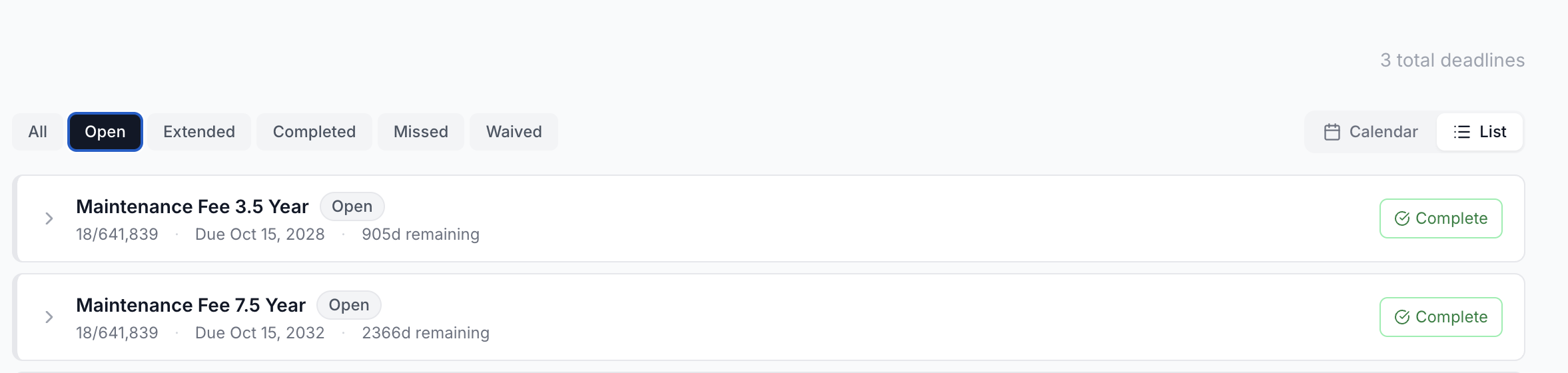
Automated docketing — USPTO statutory deadlines computed from prosecution events. Calendar and list views with overdue alerts.
Core capabilities
Everything Prosecution Teams Need.
Patent Quality Score
Every matter carries a per-feature quality score computed from the prosecution record: rejection-type distribution (§102 / §103 / §112 / §101), argued-around vs. amended-around per §-section, scope-delta magnitudes across the amendment chain, limitations added and removed, terminal-disclaimer status, and interview / appeal history. Reasoning is attached to every score — an attorney can see which prosecution facts moved the number.
Per-feature reasoningRejection distributionArgued vs. amendedScope magnitudes
USPTO & EPO Sync
Search any company name and pull their full patent portfolio from the USPTO and EPO in one click. Documents, metadata, and prosecution history synced automatically — including PCT, EPO Register, and 100+ international offices via OPS.
USPTO ODP
13M+ files
EPO OPS
100+ offices
Bulk importAuto-syncPCT + EPO Register
Six-Layer Portfolio Signals
Every matter carries a computed signal bundle: identity & lifecycle, time & term, operational risk, legal risk (litigation exposure, IPR/PGR), prosecution signals (OA / RCE counts, narrowing trend), and derived composites (risk status, prosecution health, enforcement readiness).
Scope Trajectory (First vs. Latest)
A canonical claim-scope summary computed after every sync: as-filed versus current claims, per-claim narrowed / broadened / added / deleted counts, limitations added or removed, and a net direction of NARROWING, BROADENING, MIXED, or STABLE.
Visual timeline per matter: office actions, amendments, arguments, allowances. Every claim-bearing event carries a snapshot; per-claim evolution and ad-hoc first-vs-any comparisons are one query away.
TimelineClaim snapshotsPer-claim evolution
Executive Portfolio Report
A read-only report across four sections — Action Items, Portfolio Health, Prosecution Activity, and Portfolio Composition — with auto-generated executive highlights. One click to DOCX.
4 sections16 queriesDOCX export
Automated Docketing Across Three Offices
Statutory deadlines computed from prosecution events with supersession cascading — USPTO response rules and RCE windows, PCT Rule 54bis Chapter II demand (22 months from priority) and Art. 19 amendment window, EPO Rule 70a and Rule 71 examination responses, and Art. 99(1) opposition (9 months from grant).